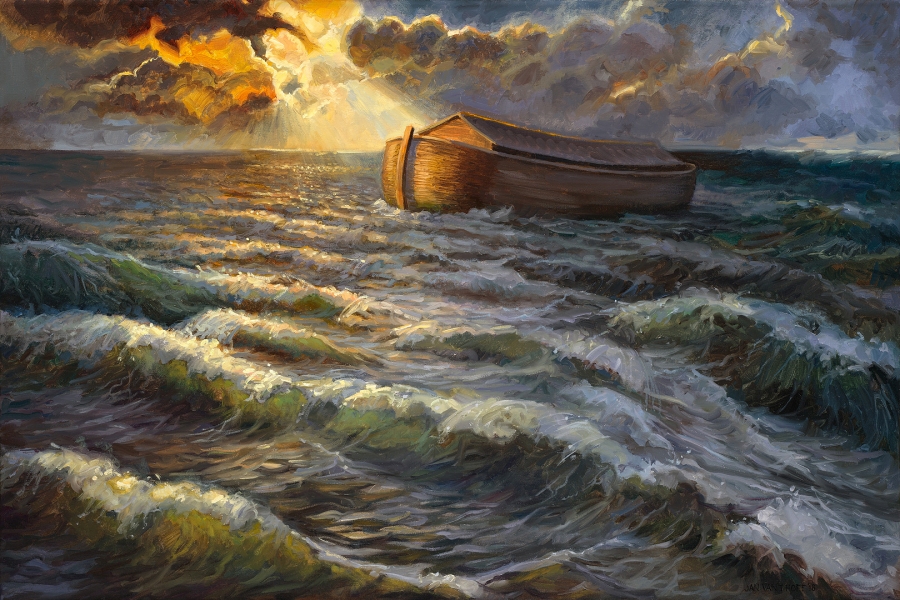
When we think about the flood story, we usually think about an angry God having a divine dummy-spit and destroying everything he had made – except for a few people and livestock.
But is that really how the Bible tells the story?
To get a better understanding, let’s first take note of a very odd turn that occurs between chapters 5 and 6 of Genesis.
If we start at the end of chapter 5 after the family tree details, we find a bloke called Lamech looking for comfort:
“When Lamech had lived 182 years, he had a son. He named him Noah, saying, “This one will bring us comfort from our labour and from the painful toil of our hands because of the ground that the LORD has cursed.”
But by the end of this passage, God is getting ready to destroy the whole world.
“I will wipe mankind, whom I have created, from the face of the earth–men and animals, and creatures that move along the ground, and birds of the air–for I am grieved that I have made them.”
Some comfort, indeed.
First let’s note that there’s a little play on words in the Hebrew text here.
When Lamech names his son “Noah” (or Noach in Hebrew), his prayer is that his son will bring comfort . ( “to bring comfort” is the translation of “yinoachmenu” in Hebrew, from “nachum”, meaning rest or comfort).
But “nacham” can be used in a different sense in Hebrew, because this word is also used when we read that God was “grieved” that he had made man.
“Nacham’ can be taken to mean “relented” or “repented” – it has a complex shade of meaning around the idea of changing direction.
So what we find is that instead of Noah bringing nacham or comfort, it is God who becomes nacham or grieved.
The prayer for comfort for mankind becomes a painful grieving in the heart of God, which sort of brings about the opposite result to what Lamech was hoping for.
“When men began to increase in number on the earth and daughters were born to them, the sons of God saw that the daughters of men were beautiful, and they married any of them they chose. Then the LORD said, “My Spirit will not contend with man forever, for he is mortal; his days will be a hundred and twenty years.”
The Nephilim were on the earth in those days–and also afterward–when the sons of God went to the daughters of men and had children by them. They were the heroes of old, men of renown.
The LORD saw how great man’s wickedness on the earth had become, and that every inclination of the thoughts of his heart was only evil all the time. The LORD was grieved that he had made man on the earth, and his heart was filled with pain. So the LORD said, “I will wipe mankind, whom I have created, from the face of the earth–men and animals, and creatures that move along the ground, and birds of the air–for I am grieved that I have made them.” Genesis 6:1-5
Before we go any further, we have to realise that the story from here can be broken into three narratives about the same event, and each narrative has three separate parts.
- Firstly, there is the executive summary, found in verses 1 to 3. This is a brief overview of the story, summarising what is going to follow.
- When men began to increase in number on the earth and daughters were born to them, the sons of God saw that the daughters of men were beautiful, and they married any of them they chose. Then the LORD said, “My Spirit will not contend with man forever, for he is mortal; his days will be a hundred and twenty years.”
- Next, we are given a little more detail (vv 4-8) about who and what was going on, and the full extent of God’s reaction is described.
- The Nephilim were on the earth in those days–and also afterward–when the sons of God went to the daughters of men and had children by them. They were the heroes of old, men of renown.
The LORD saw how great man’s wickedness on the earth had become, and that every inclination of the thoughts of his heart was only evil all the time. The LORD was grieved that he had made man on the earth, and his heart was filled with pain. So the LORD said, “I will wipe mankind, whom I have created, from the face of the earth–men and animals, and creatures that move along the ground, and birds of the air–for I am grieved that I have made them.”
- The Nephilim were on the earth in those days–and also afterward–when the sons of God went to the daughters of men and had children by them. They were the heroes of old, men of renown.
- Then finally we have a new development, (vv9-13) a hint that something else is going to happen.
- But Noah found favor in the sight of the LORD. This is the account of Noah.
Noah was a godly man; he was blameless among his contemporaries. He walked with God. Noah had three sons: Shem, Ham, and Japheth.
The earth was ruined in the sight of God; the earth was filled with violence. God saw the earth, and indeed it was ruined, for all living creatures on the earth were sinful.
So God said to Noah, “I have decided that all living creatures must die, for the earth is filled with violence because of them. Now I am about to destroy them and the earth.
- But Noah found favor in the sight of the LORD. This is the account of Noah.
In the middle of all the violence and corruption that exists, there remains one righteous man. And this righteous man stands as an enigma amongst the corruption and God’s plan to destroy the world. We are left wondering what God is going to do about this one man.
If we look closely at the text we see that each of the three stories also has three parts..
But before we go into these, let’s note a couple of side-issues.
Opinions are divided as to what the “sons of God and the daughters of men” refers to. Many believe that it refers to the sons of Seth and the daughters of Cain, but this is not really supported by the use of these terms elsewhere in the Bible. (see for example Deut 32:8, Job 1:6, Job 2:2, Job 38:7) A plain reading of the term would mean that these are heavenly beings who have descended to the earth for evil intent.
Similarly with the Nephilim. All we know is that they were a race of giants, but where they came from or where they went to, nobody really knows.
But more importantly, none of these details really matter to the main point of the story, so we don’t need to get too hung up about them.
What the story is essentially trying to convey is that things were a mess, and that mess was getting worse and worse all of the time. The normal order of creation had broken down, and we get the impression that unnatural activities were on the increase. There is something about the relationships described here that would have indicated to the original hearers that things are not what they should have been. There is a terrible perversion of the natural order occurring here somehow.
And of course, we have already noted that the introduction of Noah creates a bit of a mystery in this story – at least at this stage.
Now back to our text, where we begin each of these three stories with an introduction, then details of the corruption of the world, and finally God’s response.
So let’s have an overview of what’s happening:
| Story 1 Part A | When humankind began to multiply on the face of the earth, and daughters were born to them, the sons of God saw that the daughters of humankind were beautiful. | Introduction |
| Story 1 Part B | Thus they took wives for themselves from any they chose. | Description of evil |
| Story 1 Part C | So the LORD said, “My Spirit will not remain in humankind indefinitely, since they are mortal. They will remain for 120 more years.” | God’s response |
| Story 2 Part A | The Nephilim were on the earth in those days (and also after this) when the sons of God would sleep with the daughters of humankind, who gave birth to their children. They were the mighty heroes of old, the famous men. | Introduction |
| Story 2 Part B | But the LORD saw that the wickedness of humankind had become great on the earth. Every inclination of the thoughts of their minds was only evil all the time. | Description of evil |
| Story 2 Part C | The LORD regretted that he had made humankind on the earth, and he was highly offended. So the LORD said, “I will wipe humankind, whom I have created, from the face of the earth—everything from humankind to animals, including creatures that move on the ground and birds of the air, for I regret that I have made them.” | God’s response |
| Story 3 Part A | This is the account of Noah. Noah was a godly man; he was blameless among his contemporaries. He walked with God. Noah had three sons: Shem, Ham, and Japheth. | Introduction |
| Story 3 Part B | The earth was ruined in the sight of God; the earth was filled with violence. God saw the earth, and indeed it was ruined, for all living creatures on the earth were sinful. | Description of evil |
| Story 3 Part C | So God said to Noah, “I have decided that all living creatures must die, for the earth is filled with violence because of them. Now I am about to destroy them and the earth. | God’s response |
God looks and sees that the sons of God are marrying the daughters of men and says “My Spirit will not contend with man forever, for he is mortal (or flesh).
Now when God says “my Spirit will not contend with man forever”, we understand that God has been contending, wrestling with mankind, trying to straighten out the corruption and twistedness that has been brought into the world through sin. The word translated as “contend” is translated elsewhere in the Old Testament as “judge”, and sometimes “punish” or “vindicate”. So it seems as if God has been in a long conversation with people, trying to teach people what is right and what is wrong, but he is getting nowhere.
And this is highlighted in the second version.
6 The LORD was grieved that he had made man on the earth, and his heart was filled with pain.
So what we see in verses 5 and following, is more of an exposition of what God’s Spirit “contending” with mankind really means. We see that God becomes grieved, and his heart becomes filled with pain because of the evil that men are doing to each other on the earth.
The third parallel passage goes from verse 11 to 13. It reads: “GE 6:11 Now the earth was corrupt in God’s sight and was full of violence.
“Evil” is now described as “violence”, so it’s not simply a moral issue that God is talking about; it’s a real physical problem that is causing real human suffering.
So the earth is now filled with violence because of the corruption of humanity. Since Cain, the cycle of violence has spiralled out of control so much that now when God looks at the earth, His heart is filled with pain. We read in Genesis 1 that God looked at his original creation and said “It is very good”; but now when God looks at his creation, it only brings him grief when he sees what people are doing to each other. There is real pain in God’s heart. It’s like the difference between a child at 2 and a half days compared to a child at 2 and a half years (but ramped up a million times)!
And so we move to the third part where God decides to bring an end to the corruption and violence.
“His days shall be 120 years”; God is saying that humanity only has 120 years before He intervenes and destroys the earth.
7 So the LORD said, “I will wipe mankind, whom I have created, from the face of the earth–men and animals, and creatures that move along the ground, and birds of the air–for I am grieved that I have made them.”
Hebrew poetic style would heap up image upon image, each image adding either more information or re-stating the same information from a different perspective. And so it seems that the hundred and twenty years is a parallel statement to “I will wipe mankind … from the face of the earth.”
13 So God said to Noah, “I am going to put an end to all people, for the earth is filled with violence because of them. I am surely going to destroy both them and the earth.”
Now when God says something 3 times, you know he is serious. The creator of the universe, of the world, the plants, animals and people now decides to un-create it. He decides to destroy it because it has become corrupt.
When we look at how stories like this in the Bible are portrayed, we often see images of an angry God who is determined to wipe out evil people and those who ignore His laws.
But if read the story from the beginning of Genesis, we don’t see any image like this at all.
We have just read in the first five chapters of Genesis where a loving God creates a beautiful world and places the people he has created in a garden of abundance where they can live in a loving relationship with each other and their creator.
We have seen how these people rebelled against God and tried to elevate themselves to usurp his authority.
We have seen that when confronted with their disobedience, they turned against God, they turned against each other and they turned against the created animals (the serpent), as they tried to assign blame for their actions.
Then we see God making skins for them to help them survive in this now hostile and broken world. We see Cain murdering his brother, but being shown grace by God, with a protective mark. But then we see Cain and his offspring building cities and surrounding themselves with arts and entertainment to block out the void left by their removal from the presence of God.
Then we see the increase in violence that leads us into the beginning of chapter 6, where God’s heart has become filled with pain over what has happened; His Spirit has been contending and arguing with people, counselling, warning and urging people to change their ways and walk with Him once again; but all of God’s actions end in grief.
God “repents”, as it were, of creating humanity and decides to uncreate it. His Spirit has been urging and persuading people to change their ways, but humanity has ignored these warnings and carried on regardless, so God decides to abandon humanity to the course of destruction they have embarked upon.
So what we see is not an angry God, but a broken-hearted God. A God who wants to walk with His people, but His people keep turning away from Him and thumbing their noses at Him.
It’s interesting in verse 11, where we are told that the earth is “corrupt” and that God is going to “destroy” it, the same word (“shachath”) is used for “corrupt” as for “destroyed”. So because the world was “destroyed”, God was going to “corrupt” it.
In other words, God was going to bring the world to its logical conclusion. The world was already being destroyed, so God decided to hasten the process by bringing the flood. God, in a sense didn’t do anything different to what mankind was already doing. God simply accelerated and intensified the process.
It’s a bit like how Paul describes things in Romans chapter 2, where he says that God gave people over to the consequences of their actions. God gave people what they were asking for, and they suffered for it.
But of course, God didn’t destroy everything and everyone. Noah, the one righteous man on the earth, was saved. And through the obedience of this one righteous man, his family and a representation of all the animals on earth were also saved.
So the flood is not so much the action of an angry God destroying wicked people, as it is an evidence of a loving God who could not bear to see his creation being destroyed by the violence and corruption of people hell-bent on destruction. Rather than let the already destroyed world continue on towards total destruction, God steps in and puts a stop to it.
He wipes out the violence and destruction that has been going on, but he preserves the beginning of a new creation. He preserves a righteous man, Noah. In verse 9 we are told “Noah was a righteous man, blameless among the people of his time, and he walked with God.” And that phrase “walked with God” is a special description to indicate the kind of relationship that God wants to have with His people.
We see that it was not just Noah who was saved, but also his wife and his family. Here are the new Adam and Eve and their offspring. They will be the beginning of a new creation, one which, hopefully, will continue to walk with God.
And God is not just interested in people, but he wants to save His whole creation. So male and female of every species of animal are also saved with Noah, the beginnings of animal life in the new creation. God’s intention is to restore the whole world to how it was meant to be, and so what we see in the ark is a picture of God’s plan for the future – God living with His people, and his people ruling over the animals and the rest of creation as it was meant to be in the beginning. It’s not the end of the world, but the beginning of a new one.
Now let’s have a quick look to see how this story is used in the rest of the Bible.
Jesus talks about Noah, recorded both in Matthew 24 and Luke 17. He says “Matt 24:37 As it was in the days of Noah, so it will be at the coming of the Son of Man. For in the days before the flood, people were eating and drinking, marrying and giving in marriage, up to the day Noah entered the ark; and they knew nothing about what would happen until the flood came and took them all away. That is how it will be at the coming of the Son of Man.
So Jesus uses this story as a warning to repent and be ready to meet God on the day he visits. There will come a day, Jesus tells us, when God is going to “repent once more”, He is going to stop overlooking sin and set about removing it forever.
He is going to remake the world again once and for all. On that day, all sin and rebellion, all violence and suffering, will be wiped from the earth along with all those who promote those things. So if you are not one whose heart is filled with pain because of the corruption in the world, if you are not walking with God like Noah, then like the rest of the people in Noah’s day you will be swept away when God renews His creation.
The writer to the Hebrews, from a different angle, commends Noah as one who had faith in God and believed His promises. HEB 11:7 By faith Noah, when warned about things not yet seen, in holy fear built an ark to save his family. By his faith he condemned the world and became heir of the righteousness that comes by faith.
Noah was one who was prepared to walk with God and not join in the violence and destruction of his age. And as a result he and his family were saved.
And lastly, Peter talks about God waiting (1 Pet 3:20) “patiently in the days of Noah while the ark was being built”. This is sometimes seen as referring to the 120 years mentioned in verse 3, and again it shows a picture of a broken-hearted God who is anxious for His people to repent before it is too late.
Peter also writes in his second letter (2 Pet 2:5) “if he did not spare the ancient world when he brought the flood on its ungodly people, but protected Noah, a preacher of righteousness, and seven others; … then the Lord knows how to rescue godly men from trials and to hold the unrighteous for the day of judgment”.
So despite the corruption and brokenness of humanity in general, God is still intent on saving his creation and will rescue godly people from the destruction that surrounds them.
God’s intention is clear. He is going to fix up this world one day, and remove all the brokenness, all the violence, all the pain, all the suffering. He is going to make it a world of peace, love, wholeness and integrity once again. Anyone or anything that stands in the way of that goal will eventually be removed. But God is waiting patiently for us to turn away from rebellion and turn back to Him so that we can be healed and restored, made ready to live in that new creation.
There is a discussion going on in the church today about whether it is God who is angry with people or if it is people who are angry with God.
If we assume that God is angry with people, then we tend to adopt mottos like “turn or burn” and preach sermons like “sinners in the hands of an angry God”. Now while there is sometimes a place for these type of images, very often we run the risk of misrepresenting God through them, and frightening away the very people who God wants to befriend.
The dominant image we find in the Bible is an image of a God whose heart is broken over the stubbornness of His people and their unwillingness to return to Him. The image we find most often in the Bible is that of a God who is trying everything He can to be reconciled to His people, but His people keep turning their backs on Him and refusing to be reconciled.
“All day long”, God says (ISA 65:2) “I have held out my hands to an obstinate people, who walk in ways not good, pursuing their own imaginations– a people who continually provoke me to my very face, … who say, `Keep away; don’t come near me’,”
In Ezekiel 20, God confronts Israel with his kindness in bringing them out of Egypt, only to be rejected time and again by the very same people who received His kindness. Time and again, God pleads with His people to return to Him, but time and again, they reject God and continue to ignore God’s commands and persist in idol worship.
In Hosea 13, God says HOS 13:5 I cared for you in the desert, in the land of burning heat. When I fed them, they were satisfied; when they were satisfied, they became proud; then they forgot me.
Remember Jesus on the Mount of Olives, weeping over Jerusalem: (LK 19:41)
As he approached Jerusalem and saw the city, he wept over it and said, “If you, even you, had only known on this day what would bring you peace–but now it is hidden from your eyes. The days will come upon you when your enemies will build an embankment against you and encircle you and hem you in on every side. They will dash you to the ground, you and the children within your walls. They will not leave one stone on another, because you did not recognize the time of God’s coming to you.”
So we see consistently throughout the Bible, God in search of His people, wanting to make peace with them, pleading with them to return to Him so he can bless them and walk beside them, urging them to live under His blessing and provision.
But just as consistently we see humanity rejecting God, ignoring Him and worshipping all sorts of other gods and idols rather than the Creator.
The clearest image we have is at Easter time. God sends His son Jesus to seek and to save that which was lost. Jesus, who says “come unto me all you who are weary and heavy-laden, and I will give you rest”. Jesus, who befriends those whom society classes as sinners, and mixes with lepers, tax-collectors and prostitutes. His message is that God wants to heal sinners, not condemn them. God isn’t angry – He wants us to come to him and be healed. He wants to forgive us and restore His creation to how it should be.
But how does humanity respond to Jesus? With contempt and betrayal, with slander and abuse, until the son of God is handed over for execution on a cross.
So who’s angry with who? Is it really God who is angry with us, or are we the ones who are angry with God?
Every time we ignore Him and do our own thing. Every time we shut Him out of our lives and live as if he either didn’t exist or didn’t matter. Every time we imagine that we are the ones in control of our destiny. Aren’t we thumbing our noses at God and telling Him to get lost – that we don’t need Him?
And so when the final day comes when God calls an end to history and re-makes this world once again, what will He say to you?
“Well, you didn’t want me in your life up till now, so have it your way. Get out of my universe. Spend the rest of eternity in the same way you’ve lived your life up until now – without me.
You don’t want to walk in my light – fine, here’s the darkness, it’s all yours, forever.
You don’t want to live with my love – fine, live in your hatred and anger. It’s all yours, forever.
You don’t want the healing and restoration I am bringing – fine, live in your destruction and violence. Forever.
You don’t want the wholeness and peace I am bringing – fine, then live in your sickness and fear and emptiness. Forever.
You’re really on your own now.”
Remember what Jesus said in that passage we read before? People will be going about their everyday lives, just as they did in the time of Noah. But when the rain started, it was too late.
In the same way, when God re-creates the world again, it will be too late if you haven’t made friends with Him yet. So don’t delay. God’s waiting for you. He’s holding the door open, and the clouds are getting darker. So come to Him, and find the comfort and the rest and the healing and the wholeness that you’ve been searching for.